
Ancient Wisdom for Modern Times: The Tao Te Ching
Exploring the timeless wisdom of the Tao Te Ching and its relevance to modern life, from Wu Wei to simplicity and contentment.

Martin Michaelsen
Jan 12, 2026
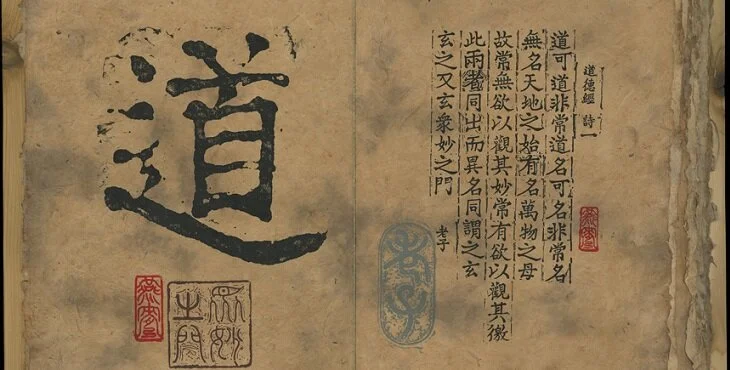
An absolute classic for me this year was the Tao Te Ching, a foundational work of Taoism. Written around the year 400 before Christ, this book tickles my brain in a way that only the best philosophy does. Considering it was written over 2,500 years ago, with the oldest excavated portions dating back to the 4th century, it’s amazing how relevant and, for lack of a better term, penetrating the wisdom within is.
The Wikipedia entry says that it’s helped inform such diverse practices as meditation, astrology, qigong, feng shui, and even something called internal alchemy, which I’m not sure is entirely a scientifically supported thing.
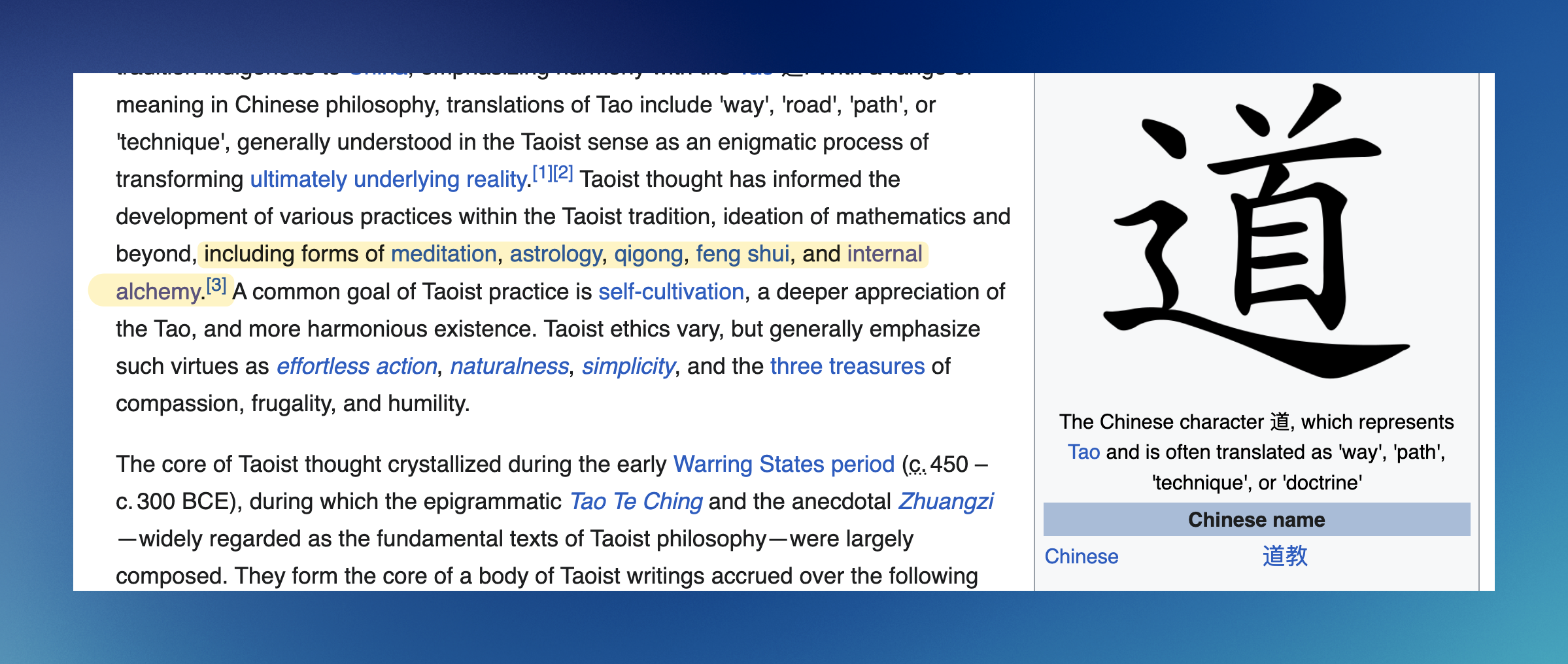
Taoism is truly complicated, but virtues such as effortless action, naturalness, simplicity are valid modern concepts that I think most people could really benefit from.
Concepts that are also part of modern science-based practices like CBT variants, ACT, MBCT, DBT, and other psychotherapies are aligned with these virtues.
And there are a couple of peer-reviewed studies explicitly treating concepts from Taoism like Wu Wei and non-striving and relating it to mindfulness and flow-like performance states.
Wu Wei: The Art of Effortless Action
Let’s tackle a key concept of Taoism, namely non-action or Wu Wei. It means effortless, spontaneous actions aligned with the natural flow of the Tao, which Taoists believe is the universe’s fundamental principle. So it’s not about laziness, but it’s the state of being where one is going with the flow.
Have you ever tried to force yourself to do something and just grind your teeth and grit it through? How did that go?
The following is paraphrased from a Tao translation I like by Derek Lin:
When we pursue the Tao, each day we reduce, detach, discard and simplify. We lose more and more complexity every day. As a result, our desires will also decrease. A simple and uncluttered life leads to peace and contentment. This process of reduction and simplification continues, until we reach wu wei - the state that is free of striving and without any unnecessary effort.
When destructive force comes their way, they do not attempt to counter it head-on with equal or greater force. Instead, they expend minimal energy and redirect it away from themselves. Thus, the swords of negativity are deflected and cannot touch them. How can they deal with life with such ease? It isn’t so much that they possess toughness, so that slings and arrows bounce off them and outrageous fortune cannot hurt them.
On Knowledge and Mastery
In closing, another section that really resonated with me was the one below.
If someone claims to know something about everything, then chances are excellent that this person has little mastery of any one subject. Being obsessed with a wide variety of book knowledge is a sign of someone who has not yet found the Tao within.
If you are curious, you can find free translations side by side at https://ttc.tasuki.org/
Or download English versions here: https://terebess.hu/english/tao/_index.html
The Gia-fu Feng translation is an excellent version to start with.
“Therefore he who knows that enough is enough will always have enough.”